
How does Emblasoft Evolver enable automation and testing over the entire service lifecycle in mobile networks?
Lifecycle automation and testing is imperative for operators that want agile, continuous delivery and innovation of network architecture and service innovation. Find out how Evolver can address every aspect of automation and testing over the four steps of the software and service lifecycle.
Agile delivery and continuous innovation and improvement is essential in today’s competitive communications landscape. The service-based 5G architecture (as well as 4G LTE networks and hybrids of) demands constant innovation to create differentiated services, the best network performance, and optimised levels of QoS and customer QoE to ensure competitive advantage.
Lifecycle automation and testing is essential for agility and innovation
Anything less and operators are likely to lose customers, and potentially damage brand reputation in such a demanding environment. To meet the demand for constant innovation and exceptional customer experience requires operators and service providers to embrace DevOps strategies utilising CI/CD/CT processes – of course, many have already done so.
At Emblasoft our mantra is: “Test early. Test often. Test Everywhere. Automate.” It’s the only way to manage the complexities of dynamically orchestrated services, network slices, and network resources, ensure that SLAs and compliance obligations are met, and protect against increasingly frequent security attacks, continuously.
It means that operators must not only test service upgrades and launches, network improvements, security patches, and so on, before launch, but also on a continual basis through active monitoring after launch.
Essentially, testing and assurance needs to be performed throughout the lifecycle of all software, services, and slices, without exception, from lab to production to launch (and for the entire lifecycle that they are live).
Automation plays an integral role here – complex tests and active monitoring must be a part of an automated testing and assurance, end-to-end strategy.
The four phases of lifecycle automation and testing
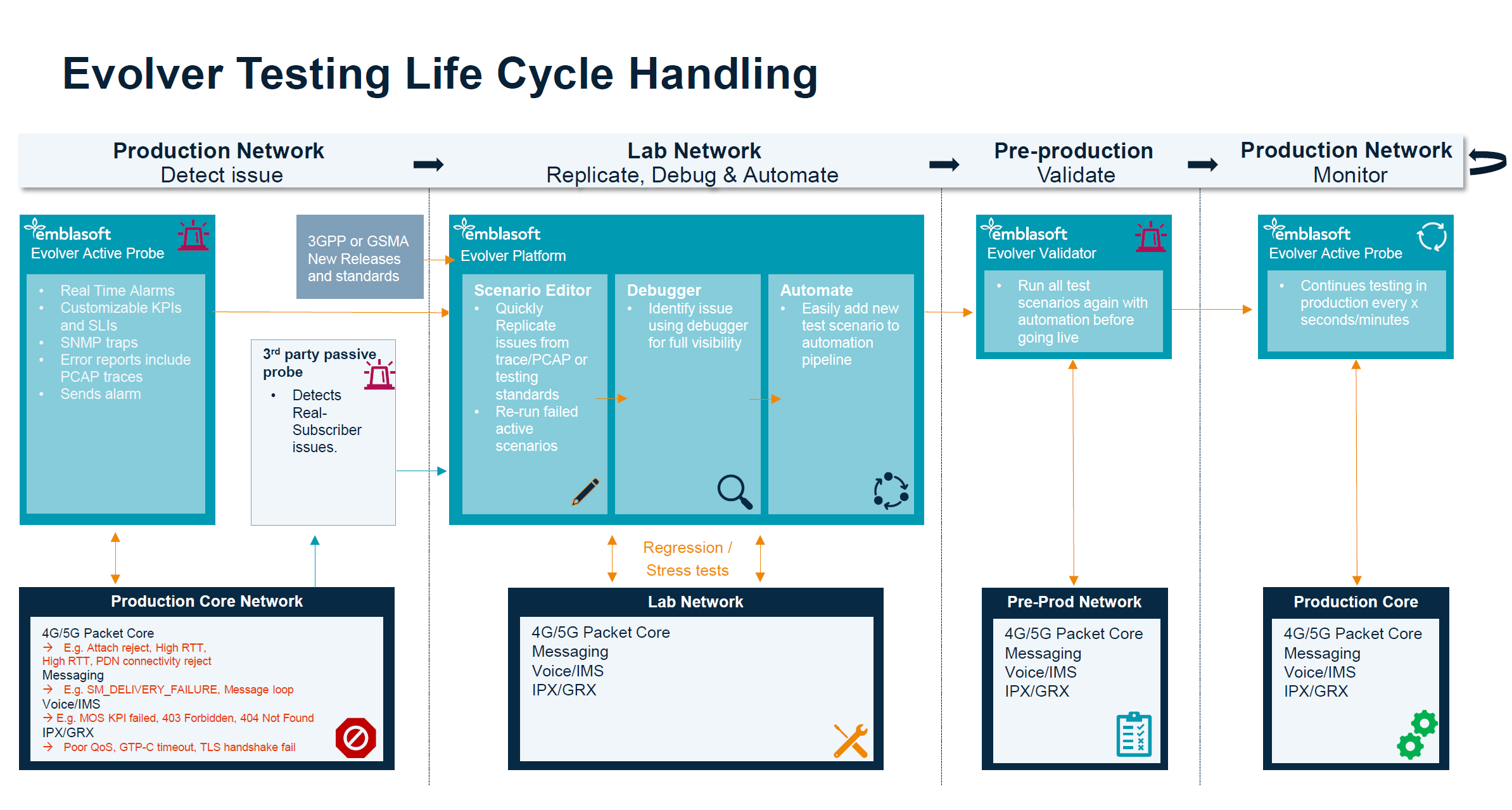
To ensure an end-to-end approach, we focus on four main phases of lifecycle automation and testing (see Figure 1):
- Production network (Detect) – Detecting network and service issues
- Lab network (Replicate, Debug, and Automate) – Replicating potential scenarios, debugging where issues are found, automation to revalidate scenarios
- Pre-production (Validate) – Validating and checking the impact of new software introductions
- Production (Monitor) – Active monitoring of the live network on a continual basis
Figure 1. Emblasoft Evolver lifecycle automation and testing
Source: Emblasoft
It’s a continuous cycle that aligns with CI/CD/CT approaches – and can be fully automated.
Evolver supports functional and regression testing for legacy and 5G networks. It’s integrated into every phase of the lifecycle, providing a virtuous loop to enable continuous, agile delivery of services and service updates.
Evolver provides complete management and optimisation of entire the process. From automation of error detection to resolution to release, and back again into the cycle.
Evolver provides a simple automation solution for functional testing throughout the lifecycle of software and services. Our aim is to give operators a solution that does not require additional tooling or competence. Importantly, we use REST APIs that can quickly and simply integrate with existing automation frameworks.
This blog is an introduction into Emblasoft Evolver’s lifecycle automation and testing functionality. Through an upcoming four-part series of blogs, we will delve deeper into what Evolver enables for each of the four lifecycle phases.
To find out more, keep an eye out for our upcoming articles, or contact us today.