
How Emblasoft helps you to assure IPX in an increasingly complex landscape – part 1 in a new series
IP Exchange – or IPX as it is more commonly known - is fundamental to how operators support data services, particularly for roaming. Well-established, it’s a critical enabler for your service portfolio. IPX, though, is evolving – which means there’s both more to consider and more opportunities to monetise.
Service assurance for your IPX services is essential. That applies both for live services and for updates and new releases that are delivered from your lab and staging networks. The problem is that, not only is the diversity of services enabled by IPX set to grow, but that the underlying network architecture and enabling elements are also changing, as virtualisation extends to every network and service domain.
Emblasoft has been helping operators assure their IPX services, across their full lifecycle for years. Our solutions align with modern automation frameworks and provide the test and assurance capabilities at every step – from lab to live. In this new series of articles, we’ll share insights gained from our engagements and from the growing community of Evolver users – across a diverse range of use cases.
First, though, let's briefly look at this landscape. As you can see, it's a complex environment, spanning multiple generations of technology, all of which much function in parallel. We'll focus on different layers and architectural components in subsequent posts - but, this is just a glimpse of where we are today - and where we are going.
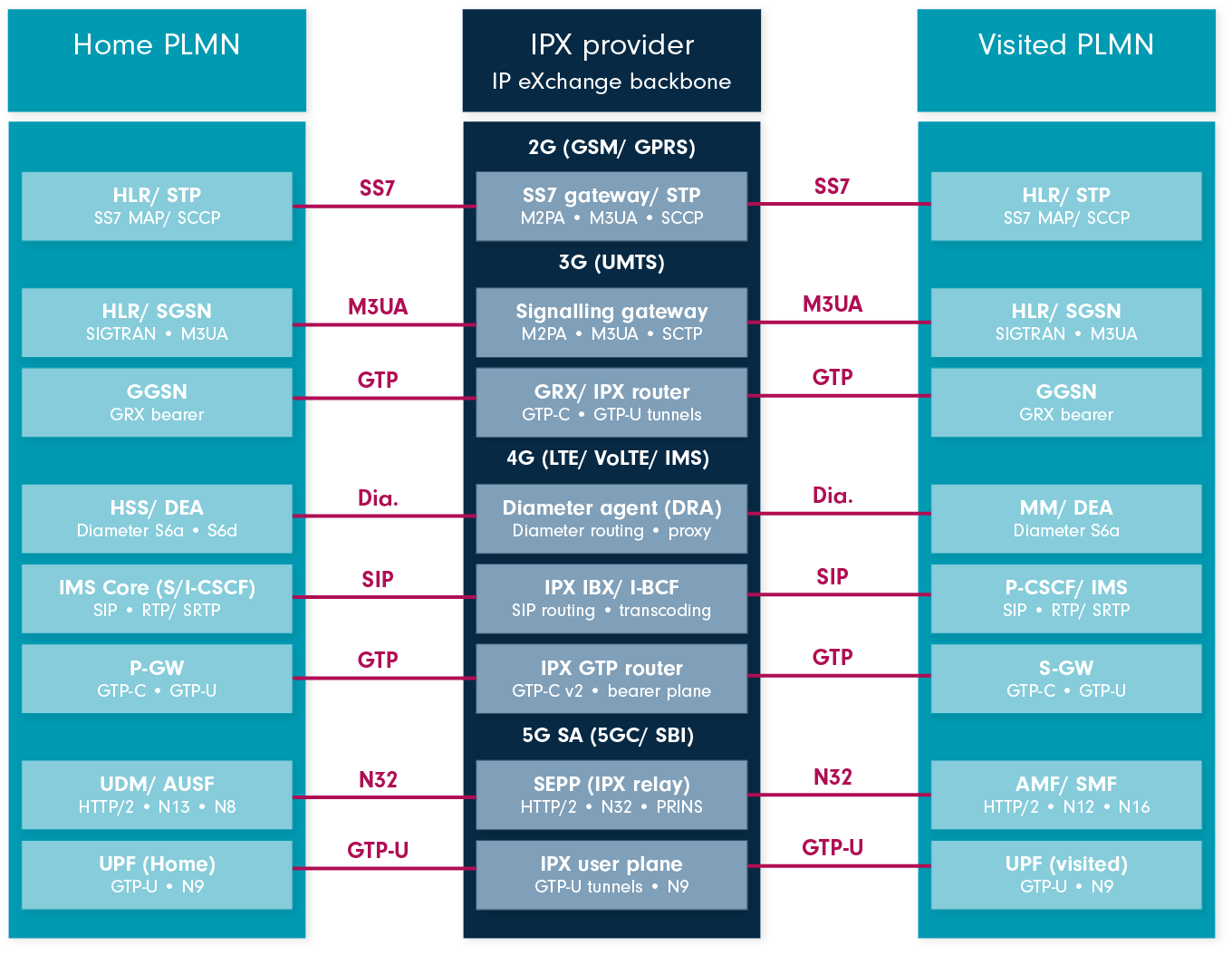
What’s happening with IPX?
We’re entering a period of change and transformation. The classical IPX framework, which has delivered for many years is about to get more complicated. For example, there is the ongoing transition to cloud-native architectures, backed by enhanced automation.
The different rates at which operators are adopting and deploying the latest cloud infrastructure and retiring legacy, physical architectures, means that ensuring service consistency and meeting performance expectations for new cloud-native solutions represents an ongoing challenge.
Further, as we will see in Part 5 of this series, service demands and applications are also evolving: when 5G SA roaming takes off, operators will want to capitalise on enhanced services enabled by slicing – but will face the challenge of delivering specified QoS and performance metrics, as well as meeting strict SLA terms.
And, there’s the ongoing challenge of security, with global threats increasing and bad actors targeting vulnerabilities in your networks, both known and, as yet, unknown to you. Vigilance and threat detection are not sufficient – updates to your network need to be rolled out on a continual basis, further complicating the service evolution lifecycle.
How Emblasoft helps
We will explore specific domains and areas in which we help you meet IPX assurance challenges in subsequent articles in this series. Our focus, meanwhile, is on delivering a unique combination of capabilities to operators that depend on our solutions to assure their IPX services:
- Validation testing
- Ultra-high performance and load testing
- Active monitoring
- Passive monitoring
These capabilities are required at different stages of the service and solution lifecycle, and our solution combines these into a single platform that maximises ROI.
For example, passive monitoring provides data about the past performance of a network and so provides significant information and insight, as well as notification of real-time events. On its own, however, passive monitoring provides insights – but it can’t give a complete picture of user experience at the UE level.
With active monitoring, software agents are deployed that mimic real users in the live network, generating synthetic traffic to continuously validate core network performance. Agents can be tuned to simulate specific services and user scenarios on demand — giving operators an accurate view of service quality before subscribers experience any issues that can also be correlated with data from passive monitoring – like from our nScan solution — to provide an enriched view of conditions in your networks – and hence support dynamic assurance programmes.
Similarly, Evolver enables end-to-end testing and functional testing of individual elements for individual scenarios as well as at full load. We offer specific scripts to validate and measure performance for different security guidelines from organisations like the GSMA, such as FS.11 and FS.19, for example.
We also partner with security specialists to deliver penetration testing, to validate network defences. Capabilities include:
- Attack Surface Management (to identify vulnerabilities on your network and recommend appropriate solutions); and
- Intrusion Detection System to detect malicious activity on different protocols and take remedial action,
Backed by a vulnerability knowledge base of more than 2,000 telecom vulnerabilities across all protocols and major equipment vendors. The changing environment matters, so that’s why we also maintain compliance with GSMA and 3GPP specifications, for example, so Evolver is always aligned with other solutions you deploy in your IPX and other network domains – and can be used to revalidate security before deploying updates, as well as when they reach the live network.
Our solutions can also help you implement a digital twin for your IPX services and infrastructure – from which you can then model performance, measure and assess threat protection, and much more, whether in your live network with active and passive monitoring, or in your lab, pre-production or staging environments.
Emblasoft Evolver helps you assure your IPX services, as the landscape becomes increasingly complex and challenging, and more services are introduced – from the lab to live. In subsequent articles in this series, we’ll explore this changing landscape, while also reviewing emerging opportunities – covering what this means for your operational systems, applications and architecture.