
Lab network testing: Replicate, Debug, and Automate with Emblasoft Evolver
Replicate, debug, and automate — functional and stress testing for your lab network. Your lab network is where you replicate issues observed in the production network so that you can implement fixes.
It’s also where you validate new releases and updates before deployment. To accomplish all of this – with the necessary agility – you need a versatile solution that covers all your protocols and interfaces: Evolver.
In this third blog in our five-part series on lifecycle automation and testing we will consider how the Emblasoft Evolver platform can enable multiple scenarios to be tested, debugged, and regression and stress testing automated in your lab.
In our previous blog on the production network we discussed how it’s essential to test new services, upgrades, and security patches across multiple scenarios, and to keep up with changes to new mobile releases and standards introduced by 3GPP, GSMA, and others, for example. We also discussed the importance of using active monitoring and introducing alerts and alarms to detect issues post-launch using active monitoring and how this complements your investments in passive probes.
Replicate, Debug, and Automate with regression and stress testing
Your lab network is your essential proving ground for validation, troubleshooting and more. It’s where you try to replicate observed scenarios, debug issues – and, having taken remedial action, demonstrate that the issues have been resolved. In this context, automation to accelerate processes has become essential.
Your lab network will, obviously, include elements of all your deployed networks, running in isolation, so that it provides a safe, secure environment for experimentation.
Troubleshooting
When issues are identified in the production network, they typically need to be replicated in lab conditions so we can understand their wider impact. Doing so means creating scenarios in which the issue is triggered and then carefully understanding what this means for the underlying network and related services.
By replicating them, we can also work out how to fix them, as we can focus on the root cause.
Service updates and patches
When you have replicated the issue and determined how to resolve it, you need to test the resulting fix. Similarly, before you release a new update into the wild, you need to be sure that it has passed all relevant quality tests.
So, the release must be tested to ensure that it delivers according to the desired specification – does it do what it should, without impacting other services and, if it’s a fix, does it close the issue?
Regression and performance testing
But there’s much more to consider. When we release new updates, we also must go beyond the specific issue in question and ensure it is compatible with the existing network configuration. We all know how a fix could, inadvertently, disrupt an existing condition.
That’s why we run regression testing, to ensure that quality control is applied in a broader sense, ensuring that the new release — patch or update — has no impact on the current network configuration and supported service suite. Regression testing will include an extended suite of tests that cover a multitude of scenarios – going far beyond the testing required for a specific or limited set of scenarios.
Even that’s not sufficient, because we must run tests that ensure the update is robust under the kind of sustained load we expect in our live, production networks. So, before anything can be released, performance testing is an essential step.
And, if issues are found during any point of this cycle, we have to start again. As a result, while speed and efficiency are essential, it’s equally essential to ensure that diligence is maintained at every checkpoint.
Matching quality control with the right tools
Each of these steps has different requirements, so versatility is required – both on behalf of your lab teams and also from the tools that they deploy. Adding to the complexity of the lab challenge is keeping pace with the state of the production networks – typically spanning multiple core and access generations, as well as interconnection and wholesale services.
The Emblasoft Platform enables testing for all your lab requirements
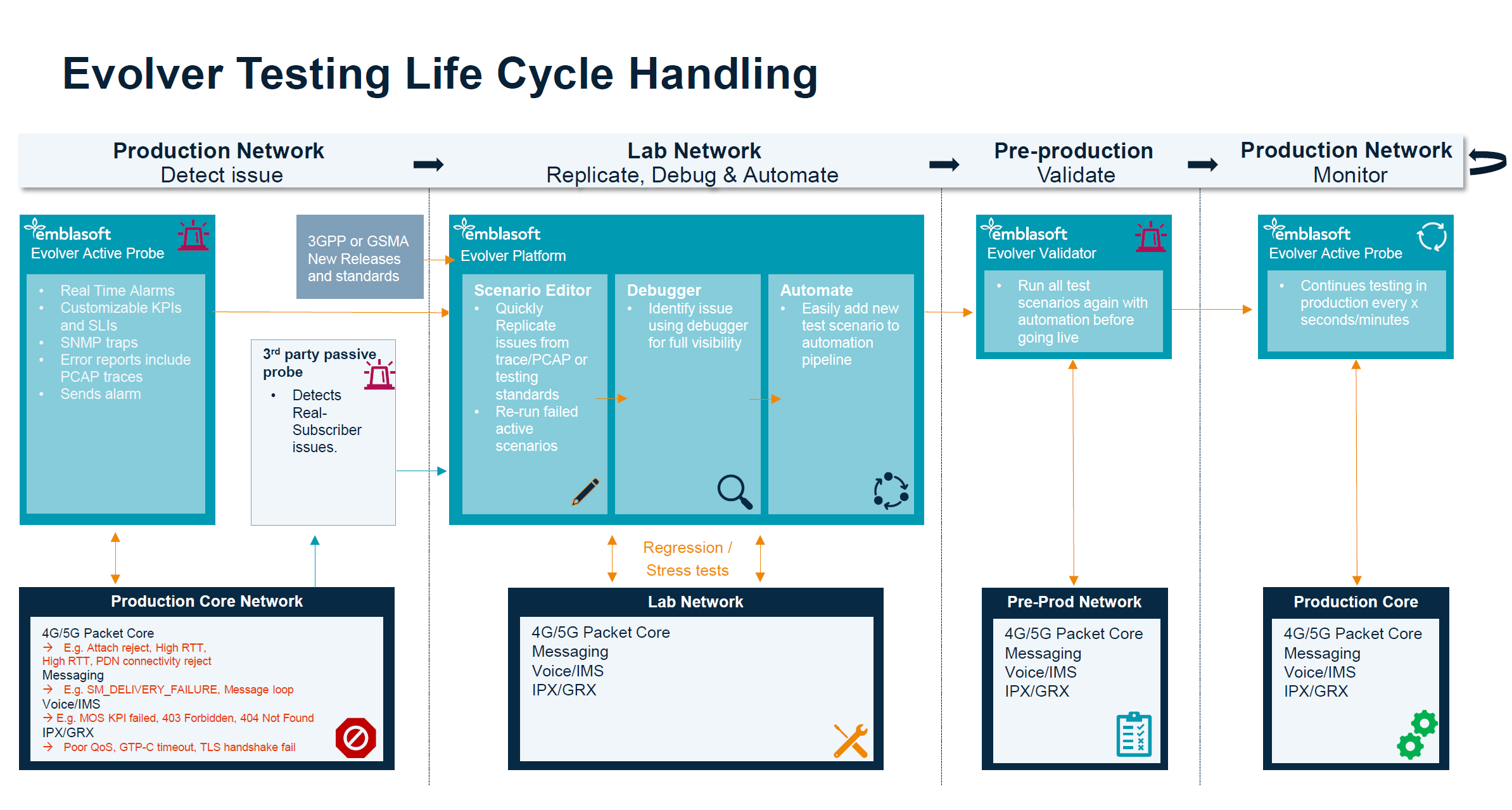
Emblasoft Evolver is designed to meet all these challenges, with full integration into your automation platform to ensure agility through lab quality control cycles – and support for all key control and user plan interfaces across the different generations of mobile networks you operate.
The comprehensive Scenario Editor allows operators to quickly replicate issues from trace/PCAP or to test standards. It also has the ability to re-run failed active scenarios from a central dashboard quickly and easily.
The Evolver Platform Debugger, meanwhile, can identify issues to provide maximum visibility into potential problem scenarios. Finally, it provides full Automation capabilities so that new test scenarios, regression and stress, can easily be added to the automation pipeline.
A pipeline allows simulations to be quickly generated, run in an ordered list at intervals that can be altered at will. Evolver Platform will then execute the test cases sequentially or in parallel.
So, when you’ve resolved a problem and validated the result, you can automatically move through the regression and performance cycles you need before updating the live network.
Our web-based GUI creates rich reports that can be automatically distributed so records and audit trails are respected. The integrated REST APIs enables tight coupling with other automation frameworks, which means full compatibility with your platforms and tools.
Evolver’s versatility provides a comprehensive automation solution for functional tests. In turn, it supports your goals of building a continuous, virtuous cycle that aligns with CI/CD/CT approaches. It gives you the functional, regression, and stress testing you need for all your legacy and 5G networks.
It’s integrated into every phase of the lifecycle, enabling continuous, agile delivery of services and service updates. To find out more contact us today.